

One pound is exactly 0.45359237 kilograms, so a pound sits a little under half a kilo and a kilo covers a little more than double the mass of a pound. Pound is the everyday term in the United States and still appears on British and Canadian labels, while the kilo is the base unit of mass in the SI and the default in most of the world. Both words name the same physical quantity, so the work on any label, recipe or delivery note is to establish which unit you are reading before you write the number down.
Jump to paragraph
What Pound and Kilo Actually Measure
In strict physics, weight is a force and mass is the amount of matter, and a scale measures the force your mass exerts on its platform while displaying the mass that force implies. Shops, kitchens and gyms use the words loosely, so a bag of potatoes marked in pounds and a dumbbell marked in kilos are both talking about mass.
The pound behind almost every grocery label is the avoirdupois pound, the unit used in the US customary system and in the Imperial system that Britain used before metrication. A troy pound exists as well and is reserved for precious metals, so a pound of silver and a pound of apples are not the same pound. Buy metal by weight and the label decides which pound applies.
The kilo has a reputation for shifting, and that reputation is out of date. The current definition agrees with the original to within 30 parts per million (0.003%), a margin no kitchen scale, bathroom scale or builders’ merchant will ever show you in normal use. For a bag of cement or a joint of meat, the difference is invisible.
Why the Kilo Is Now Tied to a Constant
For most of its life the kilogram was a metal cylinder kept under lock and key, and every national copy was checked against that one object. The definition now fixes the numerical value of the Planck constant at 6.626 070 15 × 10−34 J s, which means a suitably equipped laboratory anywhere can realise a kilogram from physics without comparing two pieces of metal in a vault.
Mass is not the only quantity handled this way. One of the SI defining constants is the luminous efficacy of monochromatic radiation of frequency 540 × 10^12 Hz, fixed by definition so that photometry can be reproduced without a reference lamp, and the same pattern runs through the whole system. Pin a constant, and the unit becomes reproducible in any laboratory that can measure to the required precision.
The pound avoided that route. It was tied to the kilogram by an exact fraction, which is why every pound to kilo conversion is a straight multiplication with no approximation built into it.
How to Convert Pounds and Kilos in Five Steps
Almost every conversion error comes from rounding too early or from reading the wrong unit, and both are easy to avoid with a fixed routine.
- Read the unit before the number, because lb and kg are easy to skim past on a scrap of paper or a delivery note.
- Write the figure down in full, decimals included, before you round anything.
- To go from pounds to kilos, multiply the pound figure by the exact value of one pound in kilograms.
- To go from kilos to pounds, divide the kilo figure by that same value.
- Round once at the end, and only as far as the task actually needs.
Steps three and four use the same number, and that is the whole advantage of an exact definition. You need the fixed value and a calculator, and nothing else.
The tool matters as much as the arithmetic. Bookmarks pointing at the historic SI Units pages at NIST now dead-end, because that site was permanently retired as of August 16, 2023, so keep a current converter or use the unit button on the scale itself. Test any converter against a known load before you trust it with a shipping form, and check whether it is converting pounds or pound-force, because the second one will hand you a number you cannot use on a parcel.
When a delivery note and your own scale disagree, ask the supplier which unit and which scale produced their figure. That one question settles most disputes faster than any amount of recalculating at the kitchen table.

Where Both Units Turn Up at Home
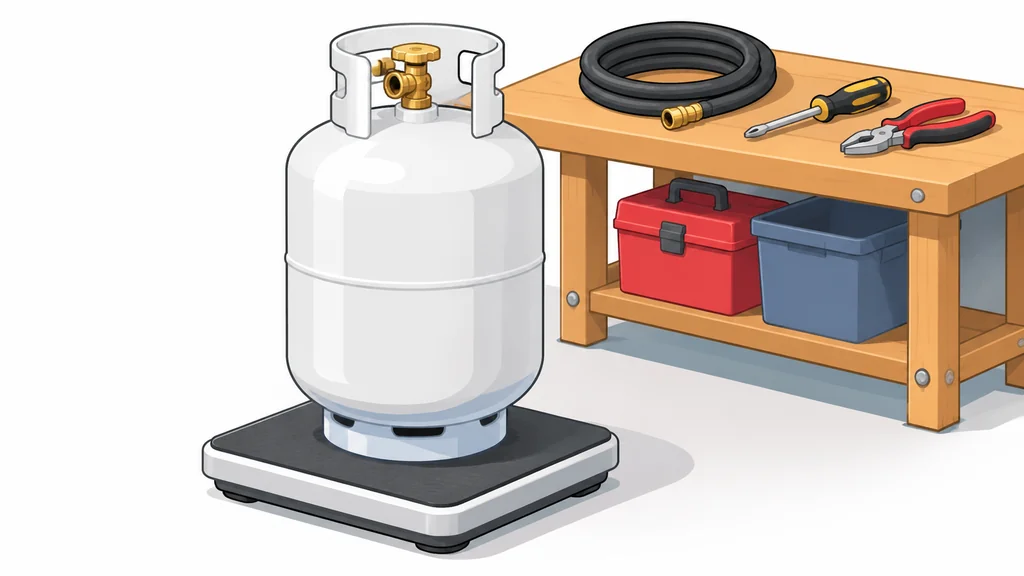
Propane shows how firmly one unit can attach itself to a product. The 20 lb LPG cylinder is the standard barbecue tank in the United States, and a 2022 NCWM-NIST national survey looked specifically at those cylinders, which tells you how thoroughly the pound owns that category. The cylinder carries its own weight markings, and on a US tank those markings are in pounds, so a swap at the refill cage depends on matching the right cylinder and reading the stamp on the collar.
Gyms run both systems side by side. Olympic bars and plates are marked in pounds in the United States and in kilograms across most of Europe and Japan, and the numbers on the two sets of plates do not line up with each other. If you follow a programme written in kilos while your gym stocks pounds, convert once and write the converted numbers on your card.
Building materials are messier. Bags of cement, compost, sand and gravel carry whichever unit the local market uses, and a bag size that looks familiar in one country often has no direct equivalent in the other. PVC pipe, timber and EPDM liner are sold by dimension, so the unit question bites on the bags and the bulk fill, where a slip between pounds and kilos is large enough to change how much you order.
Cooking is where most home cooks meet grams for the first time. A European recipe lists flour and butter in grams, a US one lists cups and ounces, and the same weighing habit pays off when you look at tomato soup nutrition and what cooking does to lycopene and other nutrients.
Labels, Recipes and Shipping Paperwork
Packaging often shows both units, and the larger figure is not always the metric one, so read the letters after the number before you read the number itself. Net weight on a food packet, a bag of ice melt or a box of deck screws follows the labelling rules of the market where it is sold, and those rules decide which unit leads. When a package carries only one unit, check the label carefully and check the local rules if that figure ends up in a quote.
Recipes scale linearly in mass and badly in volume. Doubling a recipe written in grams is a multiplication, while doubling the same recipe written in cups changes how the ingredients pack into the measure, which is why bakers who weigh their flour get more repeatable results. Convert a recipe once, write the converted weights in the margin, and work from those numbers afterwards.
Shipping adds a second trap. Carriers bill on the greater of actual weight and dimensional weight, and a form that mixes kilos and pounds can turn a light parcel into a costly one. Keep one unit through the whole quote and spell the unit out in words on the form.
Hardware is usually sold by count, and the weight printed on a box of screws or fixings is a shipping figure, so a pound of screws tells you very little about how many you get.
Body Weight and Family Records
Bathroom scales in the United States default to pounds and most of them switch to kilos with a button, and that button is the usual reason a number looks strange after a battery change. Weigh yourself at the same time of day on the same hard surface, and keep one unit in your records, because a log that flips between pounds and kilos is hard to read six months later.
Birth weights are announced in pounds and ounces in the United States and in kilos in most other countries, so new parents comparing notes across borders are often comparing converted numbers without realising it. If you are picking a provider for pregnancy care, a search for gyn obstetrics near me will serve you better than a forum thread about weight charts.
Foot pain is another place where a weight figure and a health question meet. If you are watching your weight because your feet hurt, a podiatrist doctor near me search gets you to someone who treats the cause, and the scale reading matters less than what the examination finds.

Common Mistakes and When to Ask for Help
- Reading kg as lb on a delivery note. A kilo is more than double a pound, so the error is large and it always lands on the wrong side of the deal.
- Rounding in the middle of a calculation. Round once, at the end.
- Confusing pound-force with pound. Tyre pressures, torque settings and some older specifications use force units, and those do not convert like mass.
- Treating a troy pound as an avoirdupois pound when buying metal.
- Trusting a bathroom scale with a parcel. Use a scale rated for the load and check the spec sheet.
- Dropping the unit when you copy a number into a notebook.
If a purchase, a quote or a shipment depends on the number, ask the supplier to confirm the unit in writing and keep the reply with the paperwork. Scales used for trade are regulated locally, so check the local rules if you buy or sell by weight as a business, and check the label on any imported package that looks short.
For a question about your own body weight, a clinician is the right person to ask. A bathroom scale gives you a number and nothing else, and it cannot tell you why the number moved.
Pound and Kilo FAQ
Is a kilo heavier than a pound?
A kilo is heavier. The pound is fixed as a fraction of a kilogram, so the same number of pounds always describes less mass than the same number of kilos.
Is a pound the same as a pound-force?
They measure different things. A pound is a unit of mass, while pound-force is a unit of force used in older engineering specifications, and the two do not convert the same way.
Why do some packages show pounds and grams at the same time?
The label follows the rules of the market where the product is sold, and a dual declaration lets one package serve more than one country. Read the letters after each number, because the size of the figure tells you nothing on its own.
What is a troy pound?
A troy pound is a separate unit used for precious metals and it is not the same as the avoirdupois pound used for food and general goods. If you are buying metal by weight, check the label for the unit before you agree a price.
Do I need a special scale to weigh in kilos?
Most digital scales sold for kitchens, bathrooms and workshops have a unit button that switches between pounds and kilos. Check the spec sheet for the maximum load and the resolution before you rely on one for a shipment.
Did you like article? Say thanks by clicking below: