
How accurate are fitness trackers? Reliable enough to trust for trends, not precise enough to treat as a lab instrument. Wrist-worn devices from Apple, Fitbit, Garmin, and similar brands do a solid job with step counts and resting heart rate, a middling job with heart rate during hard intervals, and a genuinely rough job with calories burned and sleep stages. That split isn’t a guess. It’s what peer-reviewed validation studies keep finding when researchers compare tracker output against lab-grade references like chest straps, indirect calorimetry, and polysomnography. Below is a metric-by-metric breakdown, sources included, so you know which number to lean on and which to treat as a rough guide.
Three reliability tiers show up across the research, and it helps to define them before you look at the table: Reliable means the error is small enough for daily use and backed by more than one study. Roughly right means the number is fine for spotting trends but not for single-day precision. Rough guide only means don’t build a decision around a single reading, especially for calories and sleep stages.
| Metric | Reliability | What throws it off |
|---|---|---|
| Steps | Reliable (Doherty 2024) | Non-walking arm motion (pushing a cart, driving), very slow shuffling pace |
| Resting heart rate | Reliable (Shcherbina 2017) | Loose fit, cold skin, movement during the reading |
| Exercise heart rate | Roughly right (Shcherbina 2017) | Wrist flexion, HIIT/interval spikes, lost skin contact |
| Calories burned | Rough guide only (Shcherbina 2017; Germini 2022) | Energy expenditure is modeled, not measured; individual metabolism varies |
| Sleep duration | Roughly right (Doherty 2024) | Telling “in bed” apart from “actually asleep” |
| Sleep stages | Rough guide only (Doherty 2024) | Light/deep/REM inferred from motion and heart rate, not brain waves |
Jump to paragraph
Are step counts accurate?
Yes, mostly, and this is the number your tracker gets closest to right. Under normal walking conditions, wrist trackers typically land within a small margin of your actual step count, a pattern that shows up across the device comparisons folded into Doherty et al.’s 2024 umbrella review.
Where it goes wrong is arm motion that isn’t gait. Pushing a shopping cart, steering a car, or typing with an active arm swing can add phantom steps. Carrying a bag or pushing a stroller, arms mostly still, tends to undercount instead. Walking speed matters too: a very slow shuffle gets missed more often than a brisk pace, because the accelerometer pattern looks less like a step.
How accurate is heart rate, and why does it lag during hard exercise?
Resting and steady-state heart rate readings from a wrist sensor are generally close to a chest strap or ECG. In Shcherbina et al.’s 2017 Stanford study, which tested seven wrist devices against a Polar chest strap in lab conditions, heart-rate error stayed low for most devices at rest and during steady effort. The picture changes once you push into intervals or HIIT.
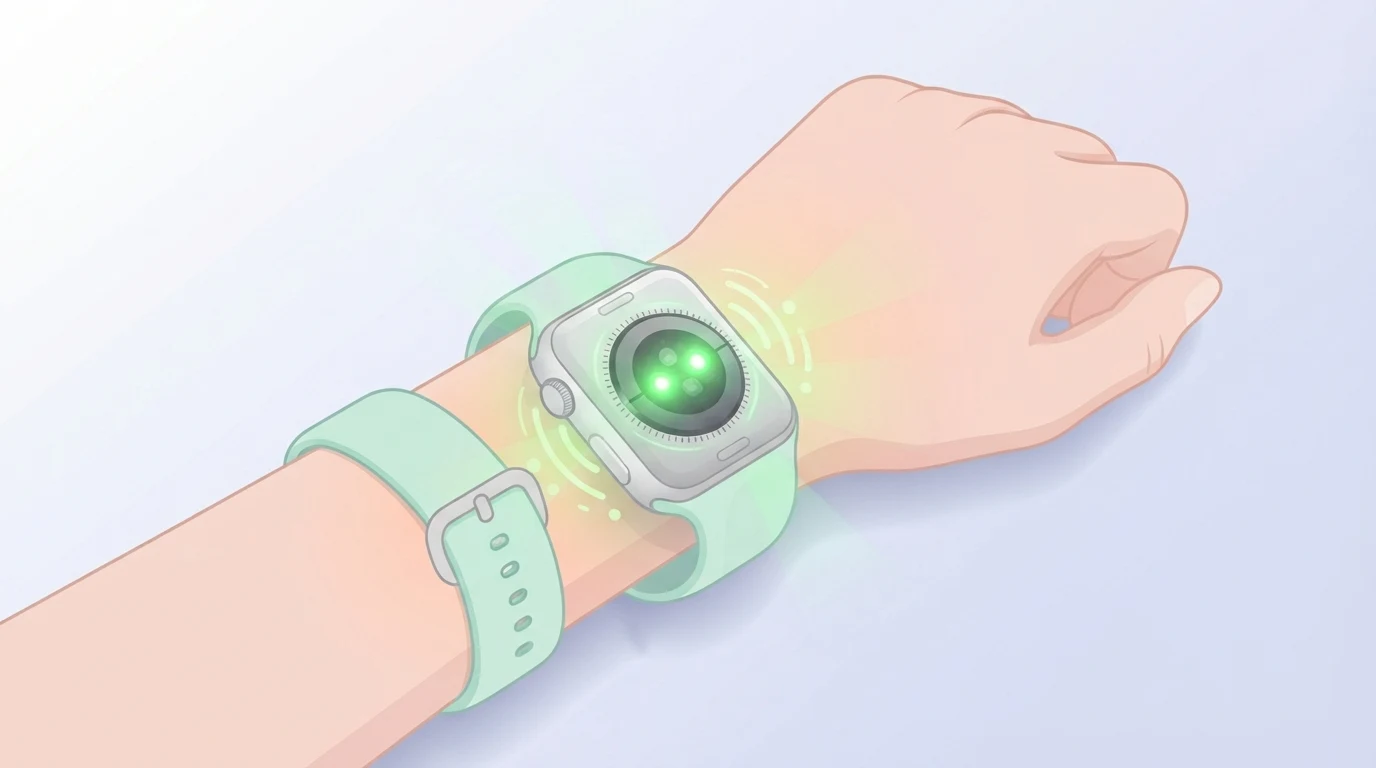
Photoplethysmography (PPG), the green-light optical sensor most trackers use, reads blood-volume changes through the skin; you can read more about how that sensor works in our guide to how wearables track your health. Wrist flexion, sudden pace changes, and vibration during hard efforts all introduce noise the algorithm has to guess through, which is the actual mechanism behind that few-beat lag you notice right after a sprint or a set. If you train by heart-rate zones for anything serious, a chest strap is still the steadier read once you’re above a jog.
Can a tracker really count calories burned?
This is the weakest number on the whole screen. Trackers don’t measure energy expenditure directly, they estimate it from heart rate, motion, and the weight, height, and age you entered, run through a proprietary formula. Shcherbina et al. 2017 found energy-expenditure error far larger than heart-rate error across the same seven devices versus a metabolic cart, with the gap between the best and worst performer wide enough to matter.
Germini et al.’s 2022 systematic review found a similar split: heart-rate accuracy across the covered wearables was generally reasonable, calorie accuracy was not. Treat the calorie number as a rough, trend-only estimate, fine for “was I more active this week,” bad for building a strict deficit around.
How accurate is sleep tracking?
Sleep duration, roughly the total time asleep, tends to be reasonably close to reality, because deciding you’re in bed versus actually asleep is a comparatively solvable problem for accelerometer-plus-heart-rate data. The reviews collected in Doherty et al.’s 2024 umbrella review point the same way: trackers estimate total sleep time better than they classify sleep stages. Splitting light, deep, and REM sleep the way clinical polysomnography does requires brain-wave (EEG) data, and no consumer optical or motion sensor measures that directly; it infers stages from movement and heart-rate patterns instead. Use the stage breakdown as a rough weekly pattern, more deep sleep this week than last, not as a diagnostic read on one night.
Why is my tracker inaccurate? (fit, motion, skin tone, tattoos)
In practice, most accuracy complaints trace back to fit and motion, not a defective unit. A loose band lets the sensor slide against the skin, breaking the contact the optical sensor needs to get a clean reading; the fix is wearing it snugger, roughly a finger’s width above the wrist bone, especially during a workout. Motion adds its own noise: arm swinging, gripping equipment, or bracing against handlebars all introduce vibration the PPG algorithm has to filter out. That motion sensitivity is the practical reason validation studies like Shcherbina et al. 2017 see heart-rate error climb during hard effort while resting readings stay close.
Skin tone, tattoos over the sensor window, and cold skin from poor blood perfusion can also change how much light the LEDs get back. This is a known mechanism of optical (PPG) sensing rather than a fixed, quantified penalty; the size of the effect depends on the device, its sensor wavelength, fit, and the reading being taken, so it is not a blanket failure for any one group. If a number looks off, compare a few consecutive readings rather than trusting one; a consistent pattern tells you more than a single data point.
Are fitness trackers accurate enough for medical use?
It depends on which feature you mean, because heart tracking on a modern watch is really three technologies with three different validation standards. Plain heart-rate display, the number on screen during a workout, is consumer-grade and was never meant to be diagnostic. ECG-based atrial fibrillation (AF) detection, on select watches like certain Apple Watch, Fitbit, or Samsung models, uses a single-lead electrocardiogram you actively trigger, and it carries clinical validation submitted for its FDA clearance (De Novo DEN180044, 2018) on select Apple Watch models (Series 4 and later), though availability varies by region, software version, and device model. It’s still a screening tool, not a diagnosis.
Separately, PPG-based “irregular rhythm notification,” optical rather than ECG, uses the same light sensor as your daily HR reading to flag a possible irregular pattern in the background. This is the feature validated at scale in the Apple Heart Study (Perez et al. 2019), and an alert still does not confirm AF on its own. Both features vary by device model, software version, and country. If you get an irregular-rhythm alert, or notice symptoms like chest pain, dizziness, or fainting, see a clinician, don’t self-manage it from the app.
How to get more accurate readings
- Wear it snug, about a finger’s width above the wrist bone, tighter during exercise than at rest.
- Use a chest strap for serious interval or HIIT training if you need precise heart-rate zones.
- Keep the firmware and companion app updated. Vendors regularly retune their HR and sleep algorithms, and the broader ecosystem of tracker-connected mobile health apps often ships accuracy fixes through software, not hardware.
- Read calories burned and sleep stages as weekly trends, not single-night or single-workout facts.
- Recalibrate your personal stats (weight, age, resting HR baseline) after major changes; they feed the energy-expenditure formula directly.
- If a reading looks wrong, check two or three more before assuming the device is broken. One-off spikes are common and usually self-correct.
The Bottom Line
Trust your tracker for direction, not diagnosis. Step counts and resting heart rate are close enough to rely on day to day. Exercise heart rate is roughly right outside of hard intervals. Calories burned and sleep stages are the two numbers most likely to mislead you if you take them literally, so treat both as trend indicators instead of facts. If a tracker gives you an irregular-rhythm or AF alert, or you notice real symptoms, that’s a cue to see a clinician, not a diagnosis to self-manage. The honest takeaway from the research: these devices are genuinely useful motivational tools that are also, on a few specific numbers, still catching up to lab-grade accuracy.
FAQ
Are fitness trackers accurate enough to count calories for weight loss?
Not precisely enough to build a strict calorie deficit around. Treat the number as a rough trend, useful for comparing your own activity week to week, rather than as an input you subtract meals against for a target deficit.
Which fitness tracker is most accurate for heart rate?
No single brand is universally most accurate. Accuracy depends more on fit, skin contact, and activity type than on brand name. Studies including Shcherbina 2017 found resting and steady-state heart rate close to a chest strap across several devices, with the gap widening for all of them during high-intensity intervals.
Can my fitness tracker detect AFib?
Some models can, through a separate ECG feature you actively trigger, not through the passive heart-rate display you glance at during a run. It works as a screening signal, not a diagnosis, in markets where it has FDA clearance (De Novo DEN180044, 2018). Availability varies by device model, software version, and country. An abnormal result still needs a clinician’s confirmation.
Why does my step count seem off?
Non-walking arm motion, pushing a cart, driving, or typing with an active arm, can add phantom steps, while carrying something with your arms mostly still, a stroller or a tray, tends to undercount. Very slow shuffling steps also get missed more often than a brisk walking pace.
Is sleep-stage tracking on a smartwatch reliable?
Sleep duration is reasonably reliable. The sleep-stage breakdown, light, deep, and REM, is the least reliable metric on most trackers, because it’s inferred from motion and heart rate rather than measured from brain waves the way clinical polysomnography does. Use it as a rough weekly pattern, not a diagnostic read on one night.
Sources
- Shcherbina A, Mattsson CM, Waggott D, et al. “Accuracy in Wrist-Worn, Sensor-Based Measurements of Heart Rate and Energy Expenditure in a Diverse Cohort.” Journal of Personalized Medicine, 2017. DOI: 10.3390/jpm6040015 | PubMed: https://pubmed.ncbi.nlm.nih.gov/28857071/
- Germini F, et al. “Accuracy and Acceptability of Wrist-Wearable Activity-Tracking Devices: Systematic Review of the Literature.” Journal of Medical Internet Research, 2022. PubMed: https://pubmed.ncbi.nlm.nih.gov/35060915/
- Doherty C, et al. “Keeping Pace with Wearables: A Living Umbrella Review of Systematic Reviews Evaluating Wearable Device Accuracy.” Sports Medicine, 2024. PubMed: https://pubmed.ncbi.nlm.nih.gov/39080098/
- Perez MV, et al. “Large-Scale Assessment of a Smartwatch to Identify Atrial Fibrillation (The Apple Heart Study).” New England Journal of Medicine, 2019. PubMed: https://pubmed.ncbi.nlm.nih.gov/31722151/
- FDA De Novo DEN180044 (Apple Watch ECG app clearance, 2018). Available at: https://www.accessdata.fda.gov/cdrh_docs/reviews/DEN180044.pdf
This article is for general information only and is not a substitute for professional medical advice, diagnosis, or treatment. If you have symptoms or a specific health concern, talk to a qualified clinician.
Did you like article? Say thanks by clicking below: