
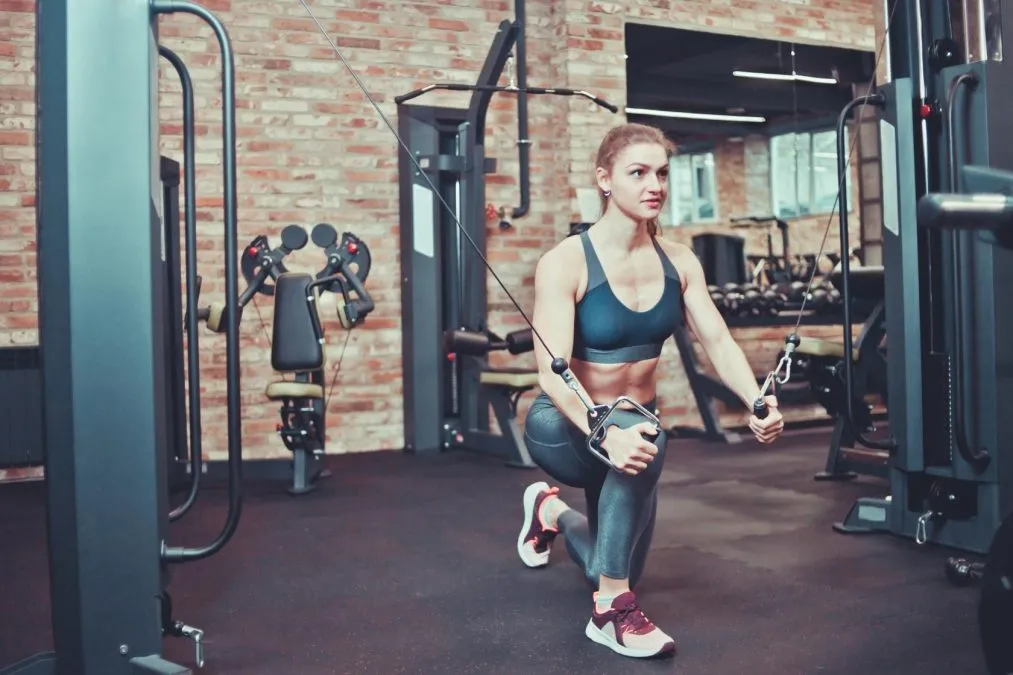
A rep, short for “repetition,” is one complete execution of an exercise movement, from start to finish and back again. Curl a dumbbell up to your shoulder and lower it under control, and you have done one rep. Do that ten times without stopping, and you have done ten reps. That is the whole idea, and everything else about programming your training is built on top of it.
Each rep works a muscle through two phases: it shortens as it contracts to lift the load (the concentric phase), then lengthens under tension as it lowers the load back down (the eccentric phase). Watch a biceps curl and you can see it plainly. As you raise the weight the biceps shortens; as you lower it the muscle lengthens while still resisting the load. String enough of those together and you start driving real change in strength or size.
This guide covers what a rep actually is, how it differs from a set, how many reps to do for different goals, and simple ways to count them without losing focus mid-workout.
Jump to paragraph
What is a rep in exercise?
A rep is a single, full run through one exercise movement. Push the bar up and bring it back down in a bench press: one rep. Stand up out of a squat and sit back down: one rep. The number of reps you complete before you stop or rest is the count that matters when you track a strength session, whether you are using a barbell, dumbbells, machines, or just your body weight.
Bodyweight moves count the same way. One push-up, lowering your chest to the floor and pressing back up, is one rep. A pull-up is one rep. The load happens to be you, but the movement is still a single repetition.
Most training programs prescribe reps in ranges rather than fixed numbers, because the right count depends on your goal and how heavy you are lifting. According to the American Council on Exercise (ACE), there is a direct relationship between how heavy the weight is and how many reps you can honestly do with it: heavier weight means fewer reps, lighter weight means more.
What is a set?
A set is a group of reps done back to back without resting. If you do 12 push-ups, rest, then do 12 more, that is two sets of 12 reps. A typical program tells you both numbers plus a rest period, written as shorthand like “3 x 12, 30 sec”: three sets of 12 reps, resting 30 seconds between each set.
So reps and sets stack together. Reps count the individual movements; sets group those reps into rounds; the rest between sets lets the muscle recover enough to keep good form on the next round. Change any of the three and you change the training effect. If you are still planning a routine, it also helps to know how many exercises to do per workout alongside your rep and set targets.
How do you count reps?

Count reps by tallying each full movement from one up to your target number. That simple approach works, but on hard sets the count itself can feel like a wall. Here are three ways to make it easier to push through.
Split the set into thirds
Instead of counting one long climb to ten, break the set into chunks. On a set of eight, count “1, 2, 3” twice and then “1, 2” at the end. On a set of ten, count to four twice and finish with two. Each third is a small, doable goal, and the last third, which is always the hardest, arrives feeling shorter than “seven, eight, nine, ten” grinding on forever.
Count backwards
Start at your target and count down to zero. Beginning a set of ten at “ten” and working toward “one” makes the number shrink as you go, so the set feels like it is getting lighter rather than piling up. Plenty of people find they squeeze out an extra rep or two this way, because stopping at “two” left on the clock feels like quitting early.
Stop counting and train to effort
Your muscles respond to how hard you work, not to a number in your head. On some sets it helps to drop the count entirely and simply take the set to the point where good form starts to break down. This works best with a spotter or on machines where a failed rep is safe. Do not train to failure on heavy free-weight lifts without a spotter, and never sacrifice form to hit a number.
How fast should each rep be?
Control the weight in both directions rather than rushing. A common, effective tempo is roughly two seconds to lift the weight, a brief pause, and two to three seconds to lower it, keeping tension on the muscle the whole time. The lowering (eccentric) phase is where a lot of strength and size gains come from, so resist the urge to let the weight drop. According to ACE, deliberately slowing the tempo increases the time your muscles spend under tension, which can make even lighter loads more challenging. Bouncing, swinging, or using momentum turns a clean rep into a sloppy one and shifts the work away from the muscle you are trying to train.
How many reps should you do?
For most training, aim for 4 to 12 reps per set, then adjust the range to match your goal. Lower reps with heavier weight build strength; higher reps with lighter weight build endurance. The table below sums up the four common rep ranges used in strength programming, in line with the ACE repetition continuum and standard training guidelines.
| Goal | Typical reps per set | Load | Best for |
|---|---|---|---|
| Muscular endurance | 12+ (often 15–20) | Light | Lasting through long efforts (rowing, circuits, CrossFit-style work) |
| Muscle size (hypertrophy) | 6–12 | Moderate to heavy | Growing bigger, more defined muscle |
| General strength | 4–6 | Heavy | Lifting more relative to your body weight; everyday strength and bone health |
| Maximal strength / power | 1–5 | Very heavy | Powerlifting, Olympic lifting, strongman (experienced lifters only) |
Muscular endurance
Muscular endurance is your muscle’s ability to keep working over a long stretch without giving out. High reps with lighter loads build it, which is why endurance-focused athletes and anyone who trains for long, repeated efforts lean toward the higher rep ranges.
Muscle size (hypertrophy)
Hypertrophy just means an increase in muscle size. If your goal is bigger glutes or a fuller back, the 6 to 12 range with a moderate-to-heavy load is the classic sweet spot, done with enough weight that the last couple of reps are genuinely hard.
General strength
General strength is your ability to move heavier loads relative to your own weight, and it carries straight into daily life: carrying groceries, lifting a child, moving furniture. Regular strength work also supports bone density and helps lower the risk of osteoporosis over time. It calls for lower reps with heavier weights.
Maximal strength and power
Maximal strength training is about moving the heaviest load you can for very few reps. It is not a starting point for beginners. Sports like powerlifting and Olympic weightlifting usually need a solid base of consistent training, often a year or more, before this kind of work is safe or useful.
Low reps and heavy weight, or high reps and light weight?

Neither is simply better; they build different things. Heavy weight for low reps skews the result toward raw strength and power. Lighter weight for high reps skews it toward endurance and muscular stamina. For muscle size, a wide middle band works well, and research shows you can grow muscle across a broad rep range as long as you take the set close to the point of real effort. Pick the end of the range that matches your goal, and match the weight so the last few reps are challenging with good form.
How do you choose reps, sets, and rest?
Start from your goal, then set the weight so you reach honest fatigue within your target rep range. If you can do eight solid biceps curls before your form slips, that is your eight-rep working weight. If you can grind out 20 with room to spare, the weight is too light for a strength goal. The right number of reps depends on your starting strength and the load, so copying whatever the person next to you is doing rarely fits you. If you are just starting out, these weight training tips for beginners cover how to pick that first working weight without overreaching.
Push each set until the muscle is genuinely fatigued but before your technique falls apart, then rest before the next set. For rest, a widely used guideline puts recovery between sets somewhere in the 30-second to 5-minute range, scaled to the goal: shorter rests (around 30 to 90 seconds) tend to suit endurance and muscle-size work, while longer rests (roughly 2 to 5 minutes) suit heavy strength and power sets where you need to recover more fully before the next effort. If you are new to lifting, a certified trainer can help you set realistic targets and a plan, but not having one is no reason to skip training.
Why bother tracking reps and sets?
Reps and sets give your workout structure and a way to measure progress. They mark your starting point and show growth over time, which is the whole basis of progressive overload: adding a rep, a set, or a little weight as you get stronger.
Tracking also keeps you honest in both directions. Seeing how close you are to your target can push you through the last few reps when you want to quit, and setting sensible rep and set goals for your current fitness level helps you avoid overtraining and the injuries that come with it.
Reps and sets for stronger bones
Resistance training does more than build muscle; the pulling force of working muscle on bone is part of what keeps bones dense and helps guard against osteoporosis. For a bone-focused program, the same rules apply: choose a weight that fatigues the target muscle within the prescribed rep range, and complete the set number your plan calls for. A common prescription is 10 to 12 reps for a given exercise, with one set counting as those 10 to 12 reps done in a row. As always, follow a specific program built for your needs rather than guessing at loads.
Frequently asked questions
What does 3 sets of 15 reps mean?
It means doing the exercise 15 times in a row (that is one set of 15 reps), resting, and repeating until you have completed three full sets, 45 reps total. The rest between each set is assumed even when it is not written out.
What does a 12-rep workout mean?
It means each set of the exercise is 12 reps: you perform the movement 12 times before you rest. A program written as “3 sets of 12” simply means doing that 12-rep set three times.
What is an example of one rep of an exercise?
One push-up is one rep: you lower your chest to the floor and press back up once. Likewise, pressing a dumbbell overhead and bringing it back down one time is a single rep. The heaviest weight you can lift for exactly one rep is your one-rep max (1RM).
How many reps are in a set?
As many as the program prescribes; there is no fixed number. A set is just a group of reps done without resting, so a set can be 5 reps, 12 reps, or 20 reps depending on your goal. Two sets of 10 push-ups, for example, gets you to 20 total.
What is a rep in strength training?
A rep is a single, complete execution of one exercise movement. Many strength programs prescribe 8 to 12 reps per exercise for general muscle building, meaning you repeat the movement 8 to 12 times before resting.
The bottom line
A rep is one complete execution of a strength movement, like a single biceps curl, and a set is a run of reps done in a row followed by rest. Choose your rep range by your goal, low reps and heavy weight for strength, moderate reps for size, high reps for endurance, and let the weight, not just the count, do the work. Track reps and sets so you can add a little each week, and you will see steadier results than lifting by feel alone.
This article is for general information only and is not a substitute for advice from a qualified fitness or medical professional, especially if you are new to exercise or have an existing health condition.
Did you like article? Say thanks by clicking below: